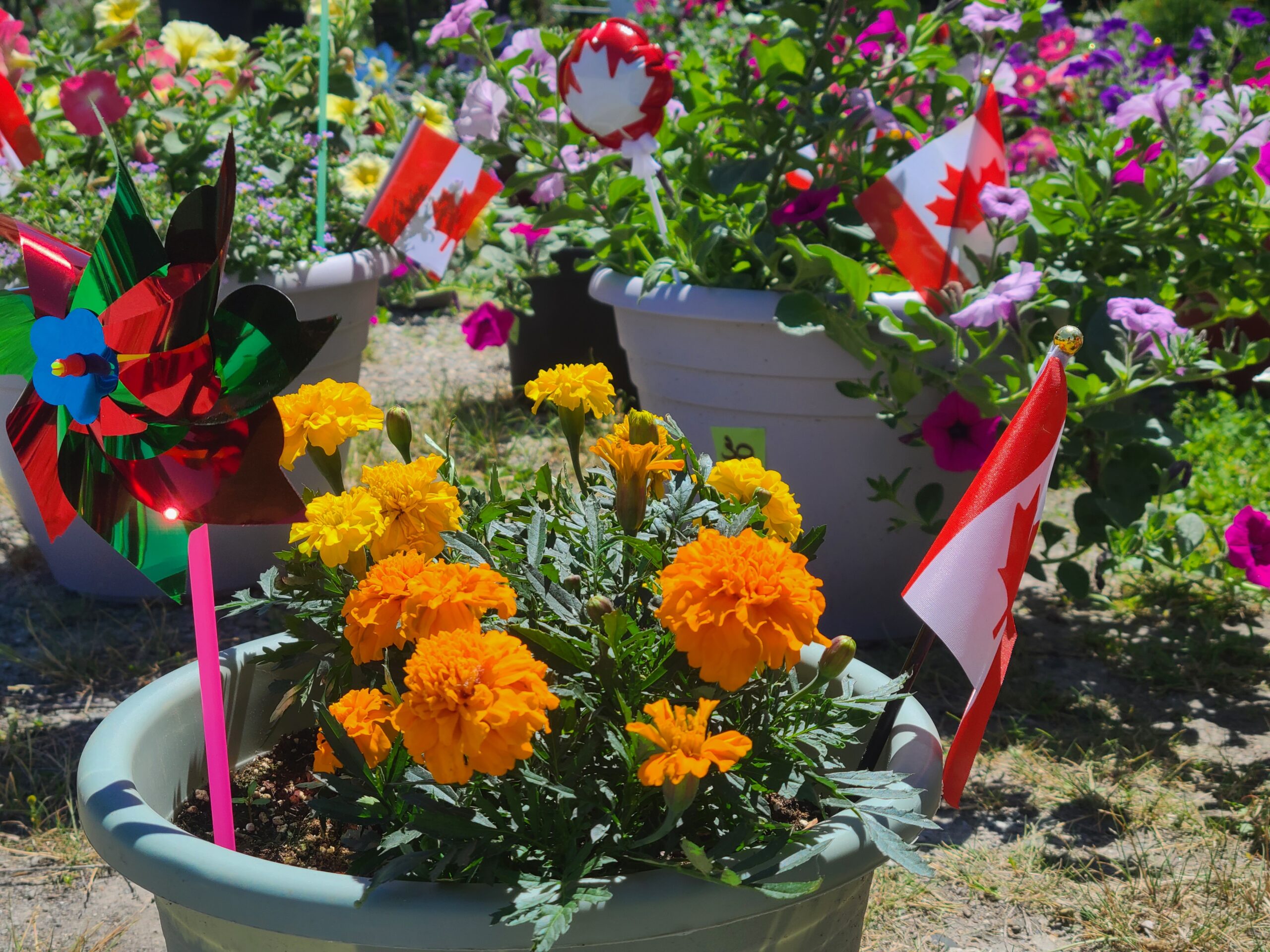
If you’re reading on Tee’s Plants, you probably love flowers. That means you might even have a favorite colour! I love orange marigolds, for example! Something you may (or may not) have experienced is, (occasionally) when you buy two of the “same” plants in different colours, they have a tendency to develop at different paces.
This can be for a variety of reasons, but let’s discuss a less commonly regarded one, the simple fact that different colours can represent a reasonable change in the genetic makeup of the plant, impacting its optimal parameters and growth patterns.
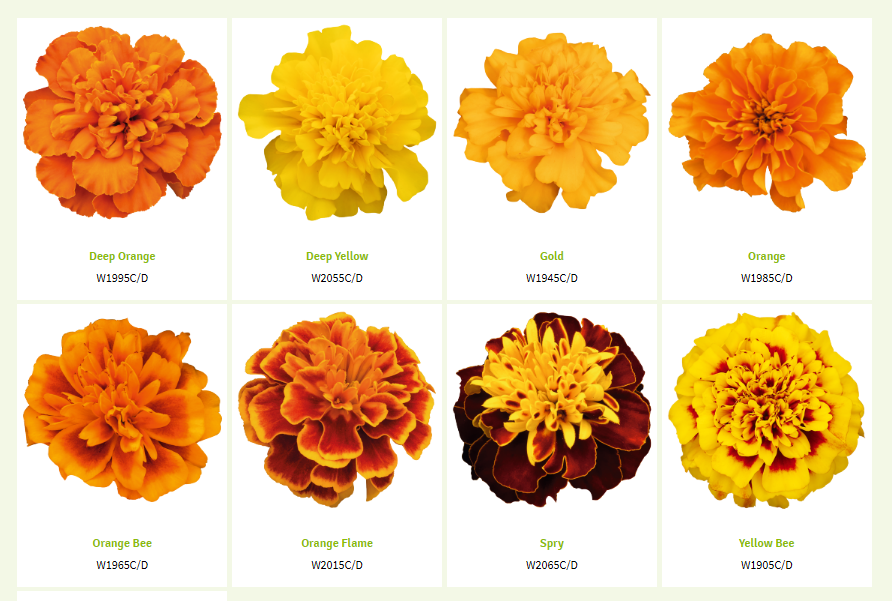
Take for example, the “French Dwarf” marigold, a classic. One of the varieties I grow every year is called Super Hero by Benary. Super Hero comes in several different colours and patterns. You can likely recognize some of the colours/patterns if you buy marigold each season – they’re very popular across Canada. Benary kindly provides growers some technical information to help succeed with their products which gives insight into how commercial facilities often grow their products.
For example, we can find in the Super Hero technical information that these specimens will respond well to growth regulators. Tee’s doesn’t use any of those! But another interesting detail is how they’ve published average flowering times for each individual colour in the series! How fascinating! And they’re wildly variable! Below is their chart indicating the days after sowing for 50% of the plants to flower.
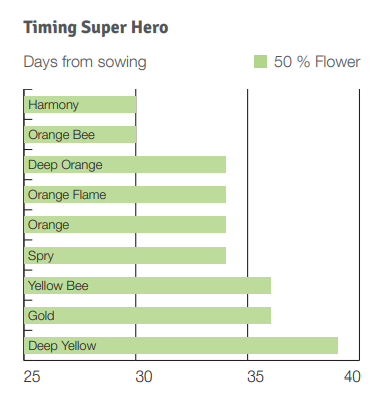
I would have to say, I certainly agree with their findings. The Deep Yellow shade takes the longest to flower for me, with reportedly over a week more of growing until you get flowers (according to this). That’s a significant difference in the greenhouse before sales! To compensate, many breeders utilize growth regulators to delay and force flowering at desired times to optimize specimen marketability. Not at Tee’s! We know that our lack of spraying sells plants by itself, and our customers appreciate plants grown in their natural state without tricks.
We have sold out of spray-free marigolds every single year, thanks to gardeners like yourself. Wouldn’t you hate to learn that your milkweed was grown nearby or even in the same facility as plants that were treated with neonicotinoids, a powerful pesticide toxic even as a residue? Thank goodness Tee’s doesn’t use anything like that!
Another interesting example of this garden phenomenon is published for Wave petunias. The breeder, PanAmerican, has a document noting different light requirements for their Wave petunia varieties. Even for specimens in the same product family, there are different minimum daylength requirements! For example, Easy Wave Rose Fusion flowers at 9 hours, but Easy Wave Blue (let’s be honest, it’s truly purple!!) flowers at 10.5 hours.
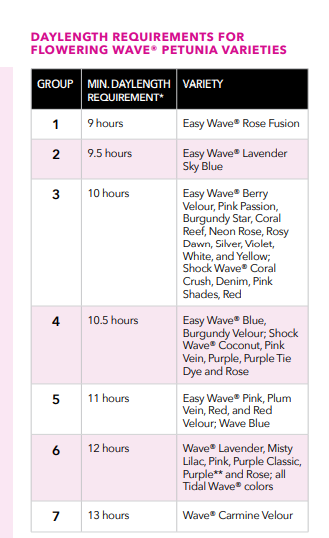
This chart proves that Easy Wave petunias are a great option for new growers, or otherwise for use in areas that don’t get the most light. Easy Wave Rose Fusion requiring 4 fewer hours than Wave Carmine Velour is a significant difference that you can implement to succeed in less sunny areas.
How does this affect your garden?
For petunias in particular, you’ll notice that some varieties, like the Tidal Wave cultivars stop flowering around October 1st here in Southwestern Ontario. That’s because the day length sinks further and further below 12 hours each day, and the plants signal to stop sending out new flowers. Healthy vigorous varieties like Tidal Waves will often then revert to vegetative growth until it gets too cold and they die.
We lose several minutes of sun each day during the fall here in Ontario. If you want petunia blooms for further into the cool season, perhaps all the way up until frost or close to Halloween, using an Easy Wave cultivar can buy you a lot more flower time.
So, if one of your plants doesn’t behave like its buddy from the same packet or nursery flat, think of these charts! They just may simply need more or less sun.